
William Butler Yeats (1865-1939)
“. . . and gather me | Into the artifice of eternity . . . ”
main page | 20th-century literature | 20th-century poetry | British poets | about literaryhistory.com
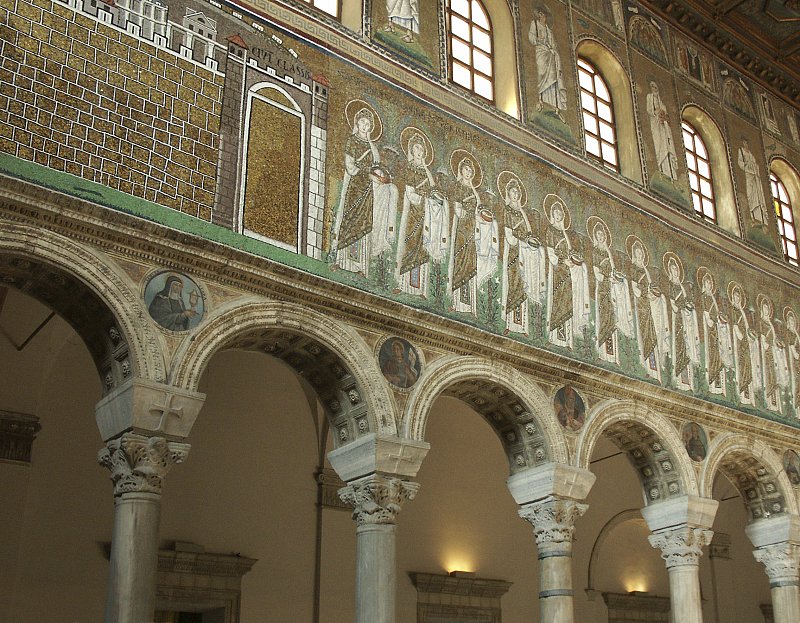
Frieze of the female martyrs, Sant' Apollinare Nuovo, Ravenna. An inspiration for "Sailing to Byzantium," says Jon Stallworthy. Photo by Mary Ann Sullivan.
introduction & biography
"William Butler Yeats." An encyclopedia-type introduction to Yeats, covers his relationship with Irish nationalism and the Celtic Revival, his poetic themes and style, his mysticism, list of his works and recommended reading. Poetry Foundation.
Hammer, Langdon. ENGL 310: Modern Poetry, William Butler Yeats. In the first of two lectures on Yeats, "The early poetry of William Butler Yeats is read and interpreted with particular attention paid to Yeats's ambitions as a specifically Irish poet. Yeats's commitment to a poetry of symbol is explored in 'The Song of the Wandering Aengus,' a fable of poetic vocation. 'A Coat,' composed at the end of Yeats's struggle to bring about an Irish national theater, shows the poet reconceiving his style and in search of a new audience. 'The Fisherman' is read as a revision of 'The Song of the Wandering Aengus' which reflects this new set of concerns." William Butler Yeats (con't) [2 lectures]. Yale U Open Courseware Spring 2007.
"W. B. Yeats." A brief introduction to William Butler Yeats, includes text of many of his most famous poems, including Yeats himself reading "The Lake Isle of Innisfree." Academy of American Poets.
"Poetry and Performance: About the Poems of W.B. Yeats." Author Josephine Hart on Yeats, for the British Library.
"William Butler Yeats." Poetry Archive. Directors, Andrew Motion & Richard Carrington.
Alkali-Gut, Karen. Selected Poems of Yeats: An Introduction, covers Yeats's early experiences and Pre-Raphaelitism. From Hakibbutz Hameuchad edition of Yeats's Poems, 2001.
"Mr Yeats's ardent new poems," a review from 1919 of "The Wild Swans at Coole." The (UK) Guardian archive.
Spurr, Barry. "W.B. Yeats." An introduction to Yeats, from a database that provides signed literary criticism by experts in their field, and is available to individuals for a reasonably-priced subscription. Also George Cusack on Cathleen ni Houlihan. Literary Encyclopedia, eds. Robert Clark, Emory Elliott, Janet Todd.
Pound, Ezra. "Responsibilities, by W.B. Yeats." Ezra Pound's review of Yeats in Poetry magazine, May 1914.
Bogan, Louise. "William Butler Yeats." An appreciation of the yet-living Yeats written in 1938, by poet Louise Bogan. The Atlantic Monthly.
literary criticism
Bizot, Richard. "Pater and Yeats." ELH 43, 3 (Autumn, 1976) pp 389-412 [free at jstor].
Bradford, Curtis. "Yeats's Byzantium Poems: A Study of their Development," in Yeats: A Collection of Critical Essays. Prentice Hall, 1963 [sub ser, questia].
Doggett, Rob. "Writing out chaos: Constructions of history in Yeats's 'Nineteen Hundred and Nineteen' and 'Meditations in Time of Civil War.'" Twentieth Century Literature 47, 2 (Summer 2001) pp 137-68 [free at jstor].
Donoghue, Denis. "Fears for Irish Studies in an Age of Identity Politics." Donoghue writes, "not only is postcolonial theory ill-suited to the Irish situation, but the interpretations of literature that it produces are shallow and one-dimensional." Chronicle of Higher Education 21 November 1997 [gone].
Donoghue, Denis. "Three Presences: Yeats, Eliot, Pound." On T.S. Eliot's responses to Yeats. The Hudson Review 62, 4 (Winter 2010) pp 563-82 [free at jstor].
Edmond, Murray. "No Paragraphs: Meditations on Noh, Poetry, Theatre and the Avant-garde." On W.B. Yeats, Ezra Pound. Jacket 16 (March 2002).
Frazier, Adrian. Behind the Scenes: Yeats, Horniman, and the Struggle for the Abbey Theatre (U of California P 1990). A free, book-length critical study. California Digital Library.
Harrison, John R. "What Rough Beast?: Yeats, Nietzsche and Historical Rhetoric in 'The Second Coming'." Papers on Language and Literature 31, 4 (Fall 1995) [sub ser, highbeam].
Jeffares, Norman A. "The Byzantine Poems of W.B. Yeats." On "Sailing to Byzantium," "Byzantium," manuscripts. The Review of English Studies 22, 85 (Jan. 1946) pp 44-52 [preview or purchase, jstor].
Kermode, Frank. "The Anglo-Irish Hyphen." Kermode reflects on a passage in Edward Said's Culture and Imperialism (1993) on "Yeats and Decolonization." Hopkins Review Winter 2008 [substantial extract, muse].
McKinsey, Martin. "Classicism and Colonial Retrenchment in W. B. Yeats's 'No Second Troy.'" Twentieth Century Literature 48 (Summer 2002) [free at jstor].
Pocock, Stephanie J. "Artistic Liminality: Yeats's Cathleen ni Houlihan and Purgatory." New Hibernia Review 12, (3 Autumn 2008) pp 99-117 [substantial extract, muse].
Ramazani, Jahan. "'A little space': the psychic economy of Yeats's love poems." Criticism 35, 1 (Winter 1993) pp 67-89 [free at jstor].
Vance, Norman. "Decadence from Belfast to Byzantium." New Literary History 35, 4 (Autumn 2004) pp 563-572 [free at jstor].
web sites
"The Life and Works of William Butler Yeats." An online exhibition, a bit frustrating to maneuver, which makes available an extensive collection of documents related to Yeats. The National Library of Ireland.
Yeats Society Sligo. Includes a selection of Yeats's poetry and commentary.
Brewer, Elizabeth. "William Butler Yeats and Postcolonialism." Brewer contends that Yeats, as a writer who devoted himself to Irish culture and literature, could be considered a postcolonial figure. From the Postcolonial literature project at Emory U.
main page | 20th-century literature | 20th-century poetry | British poets | about literaryhistory.com
1998-2018 by Jan Pridmore