main page | 20th-century literature | 20th-century poetry | modernist poets | about literaryhistory.com

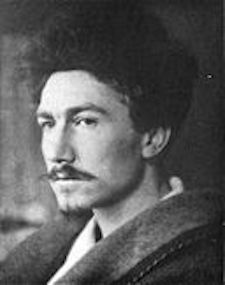
Ezra Pound photo, public domain
Ezra Pound (1885-1972)
A selective list of literary criticism for the modernist American poet Ezra Pound, favoring signed articles by recognized scholars and articles published in peer-reviewed sources
introduction & biography
"Ezra Pound." Excerpts of influential critical discussions of the following poems by Pound: A Pact, In a Station of the Metro, Portrait d'une Femme, The River-Merchant's Wife, Canto 1, Canto 9, Canto 45, Canto 81, Canto 116, Notes for CXVII. Also, articles on Pound's life and career, excerpts from Blast, Lawrence Rainey discusses the Malatesta Cantos and how through the figure of Sigismondo Malatesta Pound merged his concept of patronage with the emerging culture of Fascism. Also Pound and Fascism, Selected World War II Broadcasts, on Pound on Gender, an Ezra Pound Exhibit, and more. Ed. Cary Nelson, Modern American Poetry, U of Illinois.
"Ezra Pound." A brief biography. Also, a short piece, "Groundbreaking Book: The Cantos by Ezra Pound (1925)" and an article by poet Mark Doty on "In a Station of the Metro." Academy of American Poets.
"Ezra Pound." An encyclopedia-type article on Pound, covers his biography, major works, and critical reception, includes samples of his poems. Poetry Foundation.
Hammer, Langdon. Lecture 8 - Imagism. "The Imagist school is defined, in part through the prose of Ezra Pound. Representative examples of Imagist poetry are examined, particularly Hilda Doolittle's 'Garden,' 'Sea Rose,' and 'Oread.' Pound's early poem, 'In a Station of the Metro,' and Pound's comment on the poem's composition are studied as Imagist statements. His work with foreign languages, particularly Chinese, is considered in relation to Imagism in the poems 'Jewel Stairs' Grievance' and 'River Merchant's Wife: A Letter.'" Audio, video, and transcript from Professor Hammer's class at Yale, ENGL 310: Modern Poetry, Spring, 2007.
Hammer, Langdon. Lecture 9 - Ezra Pound. "The lecture introduces the poetry of Ezra Pound. Tensions in Pound's personality and career are considered, particularly in terms of his relationships with other poets and his fascism and anti-capitalism. The poem 'The Seafarer' is examined as a quintessentially Poundian project in its treatment and translation of poetic forms. The first Canto of his epic project, The Cantos, is analyzed as a meditation on the process of expressing and engaging with history and literary tradition." Audio, video, and transcript from Professor Hammer's class at Yale, ENGL 310: Modern Poetry, Spring, 2007.
Menand, Louis. "The Pound Error." Harvard professor Menand offers a commentary on the character and accomplishments of Pound. In the New Yorker June 9 & 16, 2008.
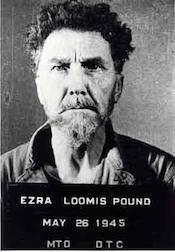
Kirsch, Adam. "Why Ezra Pound was the most difficult man of the twentieth century." In a review of a new book on Pound, Daniel Swift's The Bughouse: the Poetry, Politics and Madness of Ezra Pound, Kirsch remarks on Pound's contemporary relevance: "Now that [Pound's] obsessions seem to be staging a comeback across the Western world, his case calls for stringent judgement, rather than the sympathetic evasions it has so often inspired." In the New Statesman 28 Feb. 2017
Wilson, Peter. "Ezra Pound." An introduction, from the Literary Encyclopedia, 30 June 2002. On A Quinzaine for this Yule (1908); A Lume Spento (1908); Personae (1909); Exultations (1909); Canzoni (1911); Ripostes of Ezra Pound (1912); Cathay (1915) [subscription service].
"Ezra Pound." A very brief introduction from educational publisher Heath, includes dead links.
"On Ezra Pound." About the poetry Pound wrote during the twelve years he was confined to a ward for the criminally insane at St. Elizabeth's Hospital in Washington, D.C., and Pound's influence on Washington poetry. By Rod Jellema, in Beltway: A Poetry Quarterly.
"The Great Imitator." On Pound's reputation, development, and the new Richard Sieburth edition of his poetry for Library of America. "Pound was never overly selective in what he laid before the public, very unlike the scrupulous Eliot. In this volume we have all of his early poems, or "stale cream puffs" as he dubbed them. But as we move through the volumes that succeed it, we witness, in fascinating close-up, the making of a poet." By Stephen Romer in The Guardian 3 July 2004.
Ezra Pound reads his poetry, Recorded in 1939. From Penn Sound, a magnificent, long-running project on modern poetry at the Univ. of Pennsylvania.
literary criticism
Barton, Edwin J. "On The Ezra Pound/ Marshall McLuhan Correspondence." Barton explores the similarity in the writing styles of Pound and Marshall McLuhan. McLuhan Studies Journal 1, 1.
Beach, Christopher. A complete book length critical study available online, ABC of Influence: Ezra Pound and the Remaking of American Poetic Tradition. (U of California P, 1992) from the California Digital Library. "In this first full-length study of Pound's influence on American poetry after World War II, Beach argues that Pound's experimental mode created a new tradition of poetic writing in America. Often neglected by academic critics and excluded from the "canon" of American poetic writing, Charles Olson, Robert Duncan, and later members of this experimental tradition have maintained the sense of an American avant garde in keeping with Pound's modernist experiments of the 1910s and 1920s."
Dasenbrock, Reed Way. "Paradiso ma non troppo: The Place of the Lyric Dante in the Late Cantos of Ezra Pound." Dasenbrock poses the question, "If we have long recognized a disanalogy in terms of content and we now have begun to see a disanalogy in terms of form, how are we to explain the role Dante clearly plays in Pound's poem, particularly in the Late Cantos?" Comparative Literature Winter 2005 [preview or purchase at jstor].
Kenner, Hugh. Kenner's influential 1972 study of Pound, The Pound Era, is reviewed by Albert Gelpi. American Literature 44, 3 (Nov. 1972) [preview or purchase at jstor].
Morse, Jonathan. "The Startle Reflex: Some Episodes from the Lives of Ezra Pound's Language." A readable, erudite article from the always excellent Jacket Magazine 34 (Oct. 2007).
Perloff, Marjorie. "Pound Ascendant." Writes Perloff, "What other 20th-century poet has had so ambitious a project?.... As these new volumes remind us [Sieburth's editions of Poems and Translations and The Cantos], Pound was one of the few Modernist poets with whom the 21st century must come to terms." Boston Review April/May 2004.
Xie, Ming. "Elegy and Personae in Ezra Pound's Cathay." ELH 60, 1 (Spring 1993) [free at jstor].
main page | 20th-century literature | 20th-century poetry | modernist poets | about literaryhistory.com
1998-2018 by Jan Pridmore