main page | 20th-century literary criticism | African American literature | Harlem Renaissance poets | about literaryhistory.com

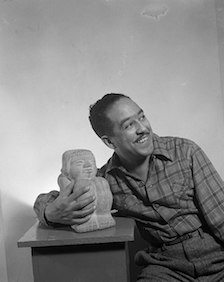
Langston Hughes photo
Langston Hughes (1902-1967)
A selective list of online literary criticism for the twentieth-century African American poet Langston Hughes, favoring signed articles by recognized scholars and articles published in peer-reviewed sources
Introduction
"Langston Hughes." Excerpts from reputable critical articles on Langston Hughes. Contents include brief discussions of The Negro Artist and the Racial Mountain; The Negro Speaks of Rivers; The Weary Blues; Harlem; The Cat and the Saxophone; Negro; Justice; Mulatto; Lynching Song; The Bitter River; Ku Klux; Letter from Spain; About the Spanish Civil War; A Hughes Spanish Civil War Broadside; Hughes, Negroes in Spain; Goodbye Christ; Christ in Alabama; Claude McKay's The Negro's Tragedy and Langston Hughes's Christ in Alabama; Let America Be America Again; Flight; Madam and the Phone Bill; About Come to the Waldorf-Astoria; White Shadows; A Right-Wing Anti-Hughes Flier; The Backlash Blues; Hughes in the 1930s; To Negro Writers; Three Hughes Book-Jackets; Hughes Bibliography; Three Songs about Lynching; About Lynching; About the Great Depression. Modern American Poetry, Cary Nelson, ed.
Hammer, Langdon. "Lecture 15 - Langston Hughes." Hammer considers Hughes's poetry in connection with other high modernist poets of the early twentieth century. "The distinctive concerns of Hughes's poetic project are juxtaposed with the works of other modernists, such as Pound, Eliot, Frost, and Stevens. Hughes's interest in and innovative use of musical forms, such as blues and jazz, is explored with particular attention to their role in African-American culture, as well as their use by Hughes to forge an alternative to dominant modes of expression within the modernist canon." Begins with a discussion of "The Negro Speaks of Rivers." Lecture 15 of Professor Hammer's class at Yale, English 310: Modern Poetry, Spring 2007.
"Langston Hughes." Brief introduction, reliable text for some of Hughes's most famous poems, other poets of the Harlem Renaissance. Academy of American Poets.
"Langston Hughes." Encyclopedia-type introduction to the poet's themes, style, and techniques, a biography, and some of his best known poems. Also "The Black Poet as Canon-Maker: Langston Hughes, New Negro Poets, and American Poetry's Segregated Past," by poet Elizabeth Alexander. Poetry Foundation.
Rampersad, Arnold. "Hughes's Life and Career." Modern American Poetry.
Nichols, Charles H., ed. "Langston Hughes." Teaching Langston Hughes, his themes, style, blues lyrics. From educational publisher Heath.
"Langston Hughes." A web site created by C-SPAN to accompany its American Writers series.
Biography
Rampersad, Arnold. A review of Rampersad's The Life of Langston Hughes. Volume I: 1902-1941. I, Too, Sing America. Reviewed by Kenny J. Williams in American Literature 59, 3 pp 447-50 [jstor]
Rampersad, Arnold. On Newly Discovered Langston Hughes Poems. "Facing racism every day with the Great Depression looming, Hughes wrote these political poems on the inside covers of a book." Poetry Foundation.
Scott, Jonathan. "Advanced, repressed, and popular: Langston Hughes during the cold war." College Literature 33, 2 (Spring 2006) pp 30-51 [free at jstor]
Bernard, Emily, ed. "The Story of an Interracial Friendship." A review of Remember Me to Harlem: The Letters of Langston Hughes and Carl Van Vechten, 1925-1964. Reviewed by Phillip M. Richards in The Journal of Blacks in Higher Education 34 (Winter 2001/2002) pp 132-3 [free at jstor]
"A Negro Intellectual Tells His Life Story." A 1940 review of Hughes's autobiographical book, The Big Sea. In the New York Times 25 Aug. 1940.
Maryemma, Graham. "Langston Hughes Centennial, 1902-1967." On the lasting influence of Langston Hughes in Crisis, an early publisher of his work. New Crisis Jan./Feb. 2002 [Questia subscription service].
"Langston Hughes." Brief biography. "I Hear America Singing," PBS.
Literary Criticism, Poetry
Dawahare, Anthony. "Langston Hughes's Radical Poetry and the 'End of Race.'" MELUS 23, 3 (Fall 1998) pp 21-41 [preview or purchase, for $42!, at jstor].
Johnson, Patricia A.; and Walter C. Farrell, Jr.. "How Langston Hughes Used the Blues." MELUS 6, 1 (Spring 1979) pp 55-63 [preview or purchase, for $42!, at jstor].
Kim, Daniel Won-gu. "'We, Too, Rise with You': Recovering Langston Hughes's African Turn 1954-1960." Kim explores Hughes's political poetry, contending that in the 1950s, "Hughes not only participated in but sought to lead the broader radicalization of the US black political imagination." African American Review 41, 3 (Fall 2007) [Questia subscription service].
Lenz, Günter H. "The Riffs, Runs, Breaks, and Distortions of the Music of a Community in Transition": Redefining African American Modernism and the Jazz Aesthetic in Langston Hughes's 'Montage of a Dream Deferred' and 'Ask Your Mama.' The Massachusetts Review 44, 1/2 (Spring/Summer 2003) pp 269-82 [free at jstor].
Miller, Marilyn. "(Gypsy) Rhythm and (Cuban) Blues: The Neo-American Dream in Guillén and Hughes." Montage of a Dream Deferred. Comparative Literature 51, 4 (Autumn 1999) pp 324-44 [preview or purchase at jstor].
Sanders, Leslie Catherine. "'I've Wrestled with Them all My Life': Langston Hughes's Tambourines to Glory." On Langston Hughes's treatment of religious subjects. Black American Literature Forum 25, 1 (Spring, 1991) [preview or purchase at jstor].
Smethurst, James. "Lyric Stars: Countee Cullen and Langston Hughes." In Hutchinson, George, ed. The Cambridge Companion to The Harlem Renaissance (Cambridge UP 2007). [Publisher's site, which provides an excerpt through the "Look Inside" tab.]
Fiction, Drama, & Journalism
Banks, Kimberly. "'Like a Violin for the Wind to Play': Lyrical Approaches to Lynching by Hughes, Du Bois, and Toomer" [and W.E.B. Du Bois, Jean Toomer]. On stylistic and symbolic choices in their representations of lynching in the short stories of three male African American writers. African American Review 38, 3 (Fall 2004) pp 451-65 [Questia subscription service].
Lamb, Robert Paul. "'A Little Yellow Bastard Boy': Paternal Rejection, Filial Insistence, and the Triumph of African American Cultural Aesthetics in Langston Hughes's Mulatto." College Literature 35, 2 (Spring 2008) pp 126-53 [jstor].
Metress, Christopher. "Langston Hughes's 'Mississippi-1955': A Note on Revisions and an Appeal for Reconsideration." On Hughes's response to the murder of Emmett Till. African American Review Spring 2003 [Highbeam subscription service].
Miller, R. Baxter. "Reinvention and Globalization in Hughes's Stories." MELUS Spring 2005 [Questia subscription service].
Ricks, Sybil Ray. "A Textual Comparison of Langston Hughes's Mulatto, 'Father and Son,' and 'The Barrier.'" Black American Literature Forum 15, 3 (Autumn 1981) pp 101-3 [preview or purchase at jstor].
Thurston, Michael. "Black Christ, red flag: Langston Hughes on Scottsboro." On "The Negro Artist and the Racial Mountain." College Literature 22, 3 (Oct. 1995) pp 30-49 [free at jstor].
Langston Hughes & Harlem
Blake, Susan L. "Old John in Harlem: The Urban Folktales of Langston Hughes." Black American Literature Forum 14, 3 (Autumn 1980) pp 100-4 [preview or purchase at jstor].
Davis, Arthur P. "The Harlem of Langston Hughes's Poetry." Phylon 13, 4 (4th Qtr. 1952) pp 276-83 [free at jstor].
Gates, Henry Louis Jr. "Harlem on Our Minds." Critical Inquiry 24, 1 (Autumn 1997) pp 1-12 [free at jstor].
Keller, Frances Richardson. "The Harlem Literary Renaissance." The North American Review 253, 3 (May/June 1968) pp 29-34 [free at jstor].
Vogel, Shane. "Closing Time: Langston Hughes and the Queer Poetics of Harlem Nightlife." Criticism 48, 3 (Summer 2006) pp 397-425 [free at jstor].
Web Sites
Draft of Langston Hughes's "Ballad of Booker T." [Booker T. Washington] A digital image of the Langston Hughes's typescript, with his autograph revisions, for "Ballad of Booker T." The Langston Hughes Collection at the Library of Congress.
The Langston Hughes National Poetry Project. From a centennial symposium on Langston Hughes, streaming audio files of symposium lectures: the keynote address by Dr. Arnold Rampersad, the biographer of Langston Hughes and many presentations by authorities and specialists on Hughes. Much more is available at this excellent site, including lesson plans. Univ. of Kansas.
main page | 20th-century literary criticism | African American literature | Harlem Renaissance poets | about literaryhistory.com
1998-2018 by Jan Pridmore