
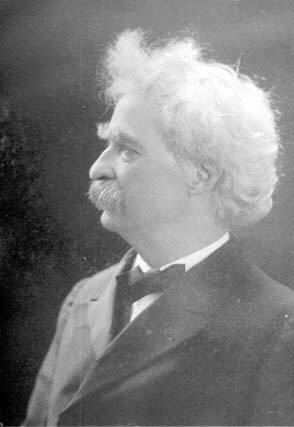
Mark Twain Visual by www.PDImages.com
Mark Twain (1835-1910)
A selective list of online literary criticism for the nineteenth-century American novelist and story writer Mark Twain, favoring signed articles and articles published in peer-reviewed sources
Main Page | 19th-Century American Writers | 19th-Century Novelists | About LiteraryHistory.com
Autobiography, Biography & Introduction
"Mark Twain." Short biography and introduction to Mark Twain, by Prof. Everett Emerson. From the educational publisher the Heath Anthology of American Literature.
"Dead for a Century, Twain Says What He Meant." "In his unexpurgated autobiography, whose first volume is about to be published a century after his death, a very different Twain emerges, more pointedly political and willing to play the role of the angry prophet." NY Times 9 July 2010.
"On Publishing Mark Twain's Autobiography." In looking for a way to tell the story of his life, Mark Twain hit upon the technology of dictation, explains historian Robert Hirst: "Instead of writing down his autobiography, Twain wanted to tell stories to another human being. And instead of telling his life story in chronological order, Twain wanted to talk about what interested him at that moment and to allow himself to change the subject as soon as his interest flagged." Extended article on the originality of Twain's approach to his autobiography, audio file available. NPR Dec. 2010.
Rexroth, Kenneth. "Mark Twain." An opinionated introduction to Mark Twain by poet Kenneth Rexroth. Orig. pub. as a review of The Autobiography of Mark Twain (1959).
"The American Novel: 1890s-1920s Naturalism." An overview of naturalism in the American novel, and some of the novelists who can be considered naturalistic. Web site from PBS.
"Regionalism and Local Color Fiction, 1865-1895." Covers American regional literature in New England, the South, Midwest, Great Plains, and West. Includes Mark Twain. Prof. Donna Campbell's web site.
"Mark Twain." Quite old criticism of Mark Twain from The Cambridge History of English and American Literature in 18 Volumes (190721)
Wasserstrom, Jeffrey N. "Traveling with Twain in an Age of Simulations: Rereading and reliving The Innocents Abroad." Common-place 4, 3 (April 2004).
Literary Criticism: Adventures of Huckleberry Finn
Arac, Jonathan. "Putting the River on New Maps: Nation, Race, and beyond in Reading Huckleberry Finn." American Literary History 8, 1 (Spring 1996) pp 110-29 [jstor prev/purchase].
Bercovitch, Sacvan. "What's Funny About Huckleberry Finn?" A renowned Americanist approaches the American "national epic." "Mark Twain's humor is deadpan at its best, and Huckleberry Finn is his funniest book. The novel draws on techniques from all three stages of his career, from his early slap-stick tales of the Wild West to his savage satires of the Gilded Age." New England Review 20, 1 (Winter, 1999) [free at jstor, click "Preview" or "Read Online"].
Bollinger, Laurel. "Say it, Jim: The morality of connection in Adventures of Huckleberry Finn." College Literature 29, 1 (Winter 2002) [jstor preview/purchase].
Boone, N.S. "Openness to contingency: Huckleberry Finn and the morality of phronesis" [philosophical questions and Huckleberry Finn]. Studies in the Humanities 31 (2004) pp 173-88 [highbeam sub ser].
Chadwick-Joshua, Jocelyn. A review of The Jim Dilemma: Reading Race in Huckleberry Finn (UP of Mississippi 1998). Reviewed by Kim Martin Long at Mark Twain Forum 10 Dec. 1998.
Colwell, James L. "Huckleberries and Humans: On the Naming of Huckleberry Finn." PMLA 86, 1 (June 1972) pp 70-76 [free at jstor, click "Preview" or "Read Online"].
Fetterley, Judith. "Disenchantment: Tom Sawyer in Huckleberry Finn." PMLA 87, 1 (June 1972) pp 69-74 [free at jstor, click "Preview" or "Read Online"].
Fishkin, S. F. Review of Was Huck Black?: Mark Twain and African American Voices (Oxford UP). Reviewed by Randall Knoper in MELUS 20, 3 (Autumn 1995) pp 151-53 [jstor prev/purchase].
French, William C. "Character and Cruelty in Huckleberry Finn: Why the Ending Works." Soundings: An Interdisciplinary Journal 81, 1/2 (Spring/Summer 1998) pp 157-79 [free at jstor, click "Preview" or "Read Online"].
Levy, Andrew. "The Boy Murderers: What Mark Twain and Huckleberry Finn Really Teach." The Missouri Review 32, 2 (summer 2009) pp 42-58 [muse substantial extract].
Margolis, Stacey. "Huckleberry Finn; Or, Consequences." PMLA 116, 2 (March 2001) pp 329-43 [free at jstor, click "Preview" or "Read Online"].
Mensh, Elaine and Harry Mensh. A review of Black, White and Huckleberry Finn: Re-Imagining the American Dream (U of Alabama P 2000) [racism in Adventures of Huckleberry Finn].Reviewed by Christopher Windolph in Southern Cultures 8, 4 (Winter 2002) pp 90-2 [muse preview].
O'Loughlin, Jim. "Off the Raft: Adventures of Huckleberry Finn and Jane Smiley's The All-True Travels and Adventures of Lidie Newton." Papers on Language and Literature 43, 2 (Spring 2007) [questia sub ser].
Scott, Kevin Michael "'There's more honor': Reinterpreting Tom and the Evasion in Huckleberry Finn." [The ending of Huckleberry Finn, racism, Leo Marx.] Studies in the Novel 37, 2 (Summer 2005) [questia sub ser].
Smiley, Jane. "Say it ain't so, Huck; second thoughts on Mark Twain's 'masterpiece.'" Novelist Jane Smiley contends that Huckleberry Finn does not deserve the high place it holds in the American canon. Harper's Magazine Jan. 1996 [enotes sub ser].
Literary Criticism: Other Works By/On Mark Twain
Berkove, Lawrence I. "'A Difficult Case': W.D. Howells's impression of Mark Twain." Studies in Short Fiction 31, 4 (Fall 1994) pp 607-15 [questia sub ser].
Cox, James M. Mark Twain: The Fate of Humor (1966) [complete book free at Open Library].
Cummings, Sherwood. Mark Twain and Science: Adventures of a Mind (1988) [complete book free at the Internet Archive].
Hirsh, James. "Covert Appropriations of Shakespeare: Three Case Studies." [Use of Shakespeare in Twain, Elizabeth Barrett Browning, and Eugene O'Neill.] Papers on Language and Literature 43, 1 (Winter 2007) [questia sub ser].
Messent, Peter. "Carnival in Mark Twain's 'Stirring Times in Austria' and 'The Man That Corrupted Hadleyburg.'" Studies in Short Fiction 35, 3 (Summer 1998) [questia sub ser].
Moore, Scott. The Code Duello and the Reified Self in Mark Twain's Pudd'nhead Wilson." American Transcendental Quarterly 22, 3 (Sept. 2008) [questia sub ser].
Rowe, John Carlos. "Mark Twain's Critique of Globalization (Old and New) in Following the Equator, A Journey around the World (1897)." The Arizona Quarterly 61, 1 (Spring 2005) pp 109-35 [preview only, muse].
Thomas, Brook. "Twain, Tourgée, and the Logic of 'Separate but Equal.'" In American Literary Realism and the Failed Promise of Contract. "Thomas investigates a host of issues at the forefront of public debate in the nineteenth century: race and the meaning of equality, miscegenation, marriage, labor unrest, economic transformation, and changes in notions of human agency and subjectivity. Cross-examining a wide range of key literary and legal texts, he rethinks the ways they relate to each other and to their social milieu." California Digital Library (U of California P 1997).
Recommended Web Sites
"The Mark Twain Papers & Project." "The combination of original and photocopied documents now makes it possible to read virtually every document in Mark Twain's hand known to survive without leaving Berkeley." The web site contains searchable databases and exhibitions on Twain's travels (Early Travels; The Mississippi River; Roughing It in the West and Hawaii; Europe and the Holy Land; England; Following the Equator; Bermuda) and on his reactions to art. Bancroft Library, U of Calif.
"A Skeptic's Progress." An online exhibition explores Mark Twain's "uneasy, often critical, attitude towards a rapidly modernizing America." Includes MSS of Twain's stories, letters, autobiographical notes. The Morgan Library & Museum.
"Mark Twain in His Times." Ed. Stephen Railton. Using manuscripts, nineteenth century reviews, images, and interactive exhibits drawn from the Special Collections at the U of Virginia, Professor Railton has created a visual web site on Mark Twain, "to allow readers, scholars, students and teachers to see what Mark Twain and His Times said about each other, in a way that can speak to us today." Includes sections on Tom Sawyer, Innocents Abroad, Roughing It, Marketing Mark Twain, and Mark Twain on Stage.
"Mark Twain's Interactive Scrapbook." A web site connected with Ken Burns's film about Mark Twain, contains suggestions for teaching Twain.
"The Twain Web," the web site of the Mark Twain Forum. Contains book reviews from book review editor Barbara Schmidt, access to the list's archives back to 1992, and several scholarly articles.
"Mark Twain Circular," the publication of the Mark Twain Society of America, contains brief notes and articles, and short, annotated current bibliographies.
Reviews & Publishers' Sites
Arac, Jonathan. Publisher's site for Huckleberry Finn as Idol and Target: The Functions of Criticism in Our Time (U of Wisconsin P 1997). "Is Huck Finn the greatest American novel, or a dangerous book? Arac calls for fairer, fuller, better-informed debates by scholars and citizens." [racism and Huckleberry Finn].
Dempsey, Terrell. A review of Searching for Jim: Slavery in Sam Clemens's World (U of Missouri P 2003). Reviewer S. F. Fishkin says, "Dempsey painstakingly shares with his readers the 'marks, traces, possibles, and probabilities' suggestive of the kind of life that a slave like the character Mark Twain calls Jim in his novel Adventures of Huckleberry Finn might have lived. This remarkable book should be required reading for anyone interested in Twain, and for anyone teaching Twain." Mark Twain Web.
Fiedler, Leslie. Publisher's site for A New Fiedler Reader (Prometheus Books), includes "Come Back to the Raft Ag'in, Huck Honey!"
Main Page | 19th-Century American Writers | 19th-Century Novelists | About LiteraryHistory.com
1998-2013 by LiteraryHistory.com