Main Page | 19th-Century Literature | British Poets, Romantic | About LiteraryHistory.com
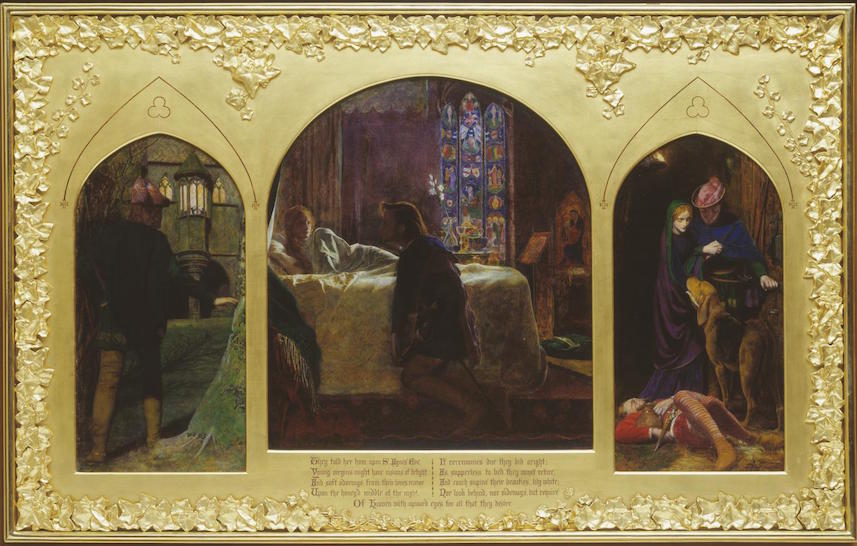
The Eve of St. Agnes, by the Pre-Raphaelite painter Arthur Hughes
John Keats (1795-1821)
A selective list of signed, peer-reviewed, and scholarly online literary criticism for the English Romantic poet John Keats
Introduction & Biography
"John Keats." A brief biography and introduction to Keats, with text for some of his most famous poems. Academy of American Poets.
"John Keats." A biography from the Poetry Foundation.
"John Keats." Contents: Overview, Keats and Romanticism, Themes in Keats's Major Poems, Keats's Odes's, Keats's Imagery, Paintings and Illustrations of Keats's Poems, and more. Prof. Lilia Melani, ed.
Colvin, Sidney. John Keats: His Life and Poetry An early biography of Keats (1917), free at questia subscription service].
Wootton, Sarah. "John Keats." An introduction to Keats, from a database that provides signed literary criticism by experts in their field, and is available to individuals for a reasonably-priced subscription. Literary Encyclopedia 28 Aug., 2002. Eds. Robert Clark, Emory Elliott, Janet Todd [subscription service].
Literary Criticism: "Ode on a Grecian Urn"
"Ekphrasis: Poetry Confronting Art." On "Ode on a Grecian Urn" and other poems about art. Academy of American Poets.
"'Ode on a Grecian Urn': Hypercanonicity & Pedagogy," James O'Rourke, ed. Twelve papers by college professors describe how they teach "Ode on a Grecian Urn." Says O'Rourke, "The essays here suggest that the canon, and American college students, have never been in better or more solicitous hands." Romantic Circles, Oct. 2003.
Hofmann, Klaus. "Keats's Ode to a Grecian Urn." Studies in Romanticism 45, 2 (Summer 2006) pp 251-84 [free at jstor, click "Preview" or "Read Online"].
Mauro, Jason. "The Shape of Despair: Structure and Vision in Keats's 'Ode on a Grecian Urn.'" Nineteenth-Century Literature 52, 3 (Dec. 1997) pp 289-301 [free at jstor, click "Preview" or "Read Online"].
Wigod, Jacob D. "Keats's Ideal in the 'Ode on a Grecian Urn.'" PMLA 72, 1 (March 1957) pp 113-21 [free at jstor, click "Preview" or "Read Online"].
Literary Criticism: "Ode to a Nightingale"
Lau, Beth. "Keats, Associationism, and 'Ode to a Nightingale.'" Keats-Shelley Journal 32 (1983) pp 42-62 [free at jstor, click "Preview" or "Read Online"].
Baker, John. "Dialectics and Reduction: Keats Criticism and the 'Ode to a Nightingale.'" Studies in Romanticism 27, 1 (Spring 1988) pp 109-28 [free at jstor, click "Preview" or "Read Online"].
Fogel, Richard Harter. "Keats's 'Ode to a Nightingale.'" PMLA 68, 1 (March 1953) pp 211-22 [free at jstor, click "Preview" or "Read Online"].
Literary Criticism: "Ode to Autumn"
Quinn, Michael. "The Objectivity of Keats's Ode 'To Autumn'" Critical Survey 2, 3 (Winter 1965) pp 146-50 [free at jstor, click "Preview" or "Read Online"].
Southam, B.C. "The Ode 'To Autumn.'" Keats-Shelley Journal 9, 2 (Autumn 1960) pp 91-8 [free at jstor, click "Preview" or "Read Online"].
Turley, Richard Marggraf. "'Full-grown lambs': Immaturity and 'To Autumn.'" Turley discusses Keats's frequently noted immaturity, and asks whether the poet had at last "grown up" in the "Ode to Autumn." Romanticism on the Net 28 (2002).
Other Studies
Gigante, Denise. "The Endgame of Taste: Keats, Sartre, Beckett." Romanticism on the Net 24 (2001).
Kenyon Jones, Christine. "'When this world shall be former': Catastrophism as imaginative theory for the younger Romantics." How early nineteenth century ideas of evolution, associated with geology and paleontology, influenced the writing of Keats and other romantics. Romanticism on the Net 24 (2001).
Kimberly, Caroline E. "Effeminacy, Masculinity, and Homosocial Bonds: The (Un)Intentional Queering of John Keats." On the development of Keats's reputation among Victorian writers. "By closely examining the publications and private correspondence of the Keats Circle during the 1820s and 1830s, one can see various patterns to the biographical development of Keats, particularly in relation to their subject's masculinity. From the widespread eulogies immediately following the poet's death, to Hunt's 1828 biographical sketch in Lord Byron and Some of His Contemporaries, to Brown's 1836 biography manuscript, threads are spun simultaneously of Keats as icon of middle-class masculinity, perpetually youthful Aesthetic ideal, and object of queered desire." Romanticism on the Net 36-37 (2004-2005).
Kucich, Greg. "'The Wit in the Dungeon': Leigh Hunt and the Insolent Politics of Cockney Coteries." Romanticism on the Net 14 (1999).
Matthews, G.M., ed. Keats: The Critical Heritage. (Barnes & Noble 1971) [complete book at questia sub ser].
Miller, Andrew J. A review of Helen Vendler's Coming of Age as a Poet: Milton, Keats, Eliot, Plath. Romanticism on the Net 32/33 (2003/2004).
Mizukoshi, Ayumi. "The Cockney Politics of Gender: The Cases of Hunt and Keats." Mizukoshi discusses upward mobility, liberal and middle-class values, and the idea of the gentleman in the cases of Leigh Hunt and John Keats. Romanticism on the Net 14 (1999).
Sandy, Mark. "Dream Lovers and Tragic Romance: Negative Fictions in Keats's Lamia, The Eve of St. Agnes, and Isabella." Sandy contends that the Romantic poets revived the traditions of the romance world, affirming their own beliefs in the dualities of innocence and experience, life and death, surface and depth, and the ideal and the real. For Keats these relations are often portrayed as an auto-erotic journey that indicates the risks of confusing fiction and fact. Romanticism on the Net 20 (2000).
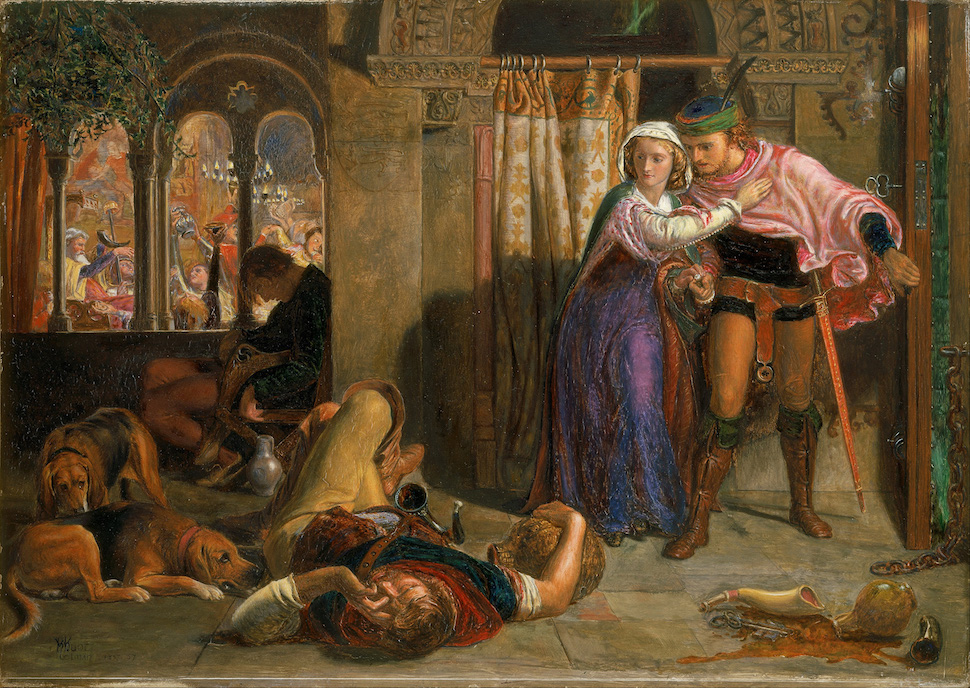
"The flight of Madeline and Porphyro," in Keat's "The Eve of St. Agnes," by the Pre-Raphaelite painter William Holman Hunt
Scott, Grant F. "Language Strange: A Visual History of Keats's 'La Belle Dame sans Merci." Studies in Romanticism 38, 4 (Winter, 1999), pp. 503-535.
Steyaert, Kris. "Poetry as Enforcement: Conquering the Muse in Keats's 'Ode to Psyche.'" Steyaert contends that critics have often characterized Keats's writing as effeminate, but fail to discern the "masculine" undercurrent in his poems. Romanticism on the Net 1 (1996).
Web Sites & Texts
"The Web Concordances." Ed. Rob Watt. Six concordances with wordlists: P.B. Shelley's Selected Poems; Coleridge's The Ancyent Marinere; Keats's Odes 1819; Blake's Songs of Innocence and of Experience; Wordsworth and Coleridge's Lyrical Ballads 1798; Gerard Manley Hopkins' Poems First Edition, 1918. Also software to make your own concordance.
Romanticism on the Net. Ed. Michael Eberle-Sinatra. An international, peer-reviewed electronic journal devoted to British Romantic studies, an impressive scholarly enterprise that has been making essays freely available since 1996.
Romantic Circles. Eds. Neil Fraistat, Steven E. Jones, and Carl Stahmer. "A refereed scholarly web site devoted to the study of Romantic-period literature and culture." An innovative publication on topics in Romanticism.
"A Romantic Natural History." Ed. Ashton Nichols. The relationships between literary works and natural history in the century before Darwin, with articles on Keats and other Romantics.
Endymion. Taylor and Hessey, 1818. First edition online through Google Books; provides page images of the entire edition, and searchable.
Main Page | 19th-Century Literature | British Poets, Romantic | About LiteraryHistory.com
1998-2017 by Jan Pridmore